Wooden Whiskey Boxes: Bottle Shape, Glassware and the Structure of a Spirits Gift Box
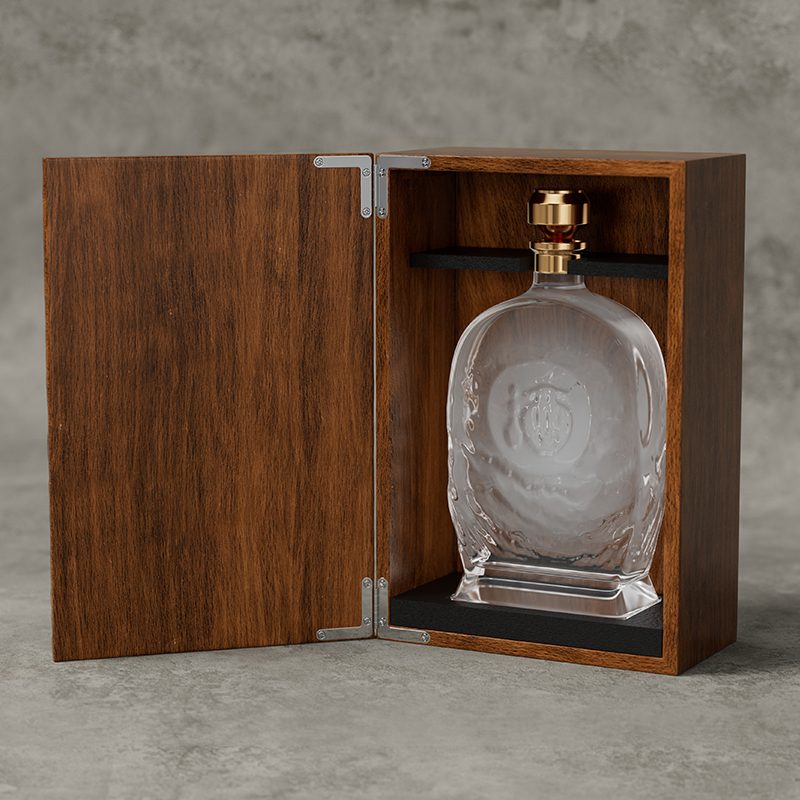
A wine case is usually specified by how many bottles it holds. A spirits gift box is specified by the bottle and what comes with it — a decanter or a square-shouldered bottle, one or two glasses, sometimes a pourer or a jigger — and by the moment the box is opened. That makes it a different brief: the insert has to hold objects of very different heights and weights in one footprint, and the box has to read as a gift rather than a shipping container.
This guide covers how wooden and leather-wrapped spirits boxes are built around that set: the bottle shapes that drive the cavity, the glassware that has to fit beside it, the formats that read as presentation pieces, and the specification decisions that decide whether a launch arrives intact.
Why a spirits gift box is a different brief from a wine case
Wine boxes are usually built around bottle count: one, two or six identical bottles, standing or lying, with dividers between them. A spirits gift set is built around one bottle plus accessories of different heights. The bottle is short, broad and heavy; the glasses are light, tall and fragile; the small metal accessories are hard and roll. Putting them in one box is closer to planning a gift set than to planning a case of bottles.
It also changes what the box is for. A wine case very often travels and is stored; a spirits gift box is displayed, opened on a table, and kept. So the exterior, the opening sequence and the finish carry more weight, while stacking strength carries less. If you brief it as a two-bottle wine case, you will get a box that protects the bottle and disappoints the person receiving it.
Start from the bottle: decanter, square shoulder and heavy base
Every dimension in a spirits box is derived from the bottle. Base diameter and footprint decide the cavity; shoulder shape decides whether the bottle needs a collar; total height and the cap decide lid depth. Spirits bottles are the awkward ones: square or sloping shoulders, a thick glass base, a short neck and a heavy stopper. A cavity cut for a tall, slim bottle will let a broad decanter rattle, and a stopper wider than the neck means the cavity needs a step cut, not an approximation.
Send a bottle drawing with base, widest body, shoulder, neck, cap and total height — and the weight, because a heavy base changes how the insert is supported. If the programme covers more than one bottle shape, say so at the start. The usual answer is a removable collar or a two-part insert, and both have to be tooled at sampling, not added later.
| Bottle feature | What it sets in the box |
|---|---|
| Base diameter and footprint | Cavity width and the cradle it sits in |
| Square or sloping shoulder | Whether a neck collar is needed |
| Cap or stopper diameter | The step in the cavity and lid clearance |
| Total height and weight | Lid depth and support under the base |
| One shape or several | Fixed insert versus removable collar |
The cradle: holding a heavy bottle upright
The insert does the work, and for spirits it does more of it than in almost any other box. A full bottle is heavy for its volume, and a thick glass base concentrates that weight on a small area. The bottle should be seated on its base on a firm cradle and held again at the neck or shoulder — never gripped at one point in the middle, where it can pivot, and never pressed on the stopper, which is usually the weakest part.
EVA and shaped foam are light and forgiving and suit a box that ships directly to a customer. Wrapped mouldings look better on a shelf and are the standard for gift sets. Rigid moulded trays hold their shape longest and suit a box that will be opened for years. Whatever the material, the cradle and the cavity must work as one system with the outer carton: a rigid insert in a loose carton still lets the box hit the carton wall.
Building in the glassware: glasses, a pourer, a jigger
Once a box holds a bottle and one or two tumblers, height mismatch becomes the main problem. The glasses are taller than they are wide and top-heavy, and they should stand in their own lined wells with a soft floor, not lie in a shared cavity where they can touch the bottle or each other. A set looks balanced only if the insert steps down to meet every item, and the lid has to clear the tallest one when it closes.
Small accessories are the easy thing to forget. A pourer, a jigger, tongs or a small booklet need shallow wells with a lip, and metal pieces should not share a space with glass. Decide the full set contents before sampling: changing one item after tooling usually means a new insert. If the set contents change by season, a shared cavity with a removable divider is worth specifying from the start.
Formats that read as a gift: double-door, slide, drawer and book-style
Spirits presentation uses structures that are rare in everyday storage boxes. A double-door or book-style case opens outward to reveal the bottle in the middle — the most ceremonial option, and the one that shows the lining and the branding at the same time. A slide-out or drawer format lets accessories sit in a pull-out tray below the bottle, which solves the height mismatch neatly. A lift-off lid box is the simplest to make and the most forgiving on tolerances, and suits an unusually shaped decanter that will not drop into a cavity cleanly.
Each format changes panel sizes, hinge or runner tolerances, and lid depth, so choose it before the insert is drawn. A drawer has to clear its sleeve without binding and needs a finger recess or a pull; double doors need hardware that stays aligned across the run. These are tooling decisions, and they are much cheaper to make in the 3D proof than after a physical sample exists.
Wood, carved detail and leather-wrapped bodies
A wooden body — solid, veneered or MDF with a lacquer — gives crisp edges, a flat surface for foil or laser marking, and the weight a presentation piece wants. Carved or openwork detail, inlay and contrasting wood grain are all at home in this category, because the box is meant to be looked at; they should be specified as part of the surface process rather than added as decoration at the end. A high-gloss lacquer shows fingerprints and dust under retail lighting; a matte or open-grain wood hides both.
A leather-wrapped body gives a softer hand-feel, a better grip when carried, and hides the scuffs a gift box picks up in a warehouse — which is why it suits carrier and trunk formats. It also moves the branding method away from laser work and toward debossing or foil, and it adds weight. Neither body is the premium option by default; the right one matches how the box will be handled and displayed.
Light, weight and the seal
Spirits boxes are often kept on a shelf for years, so two quiet details matter. A closed box should keep dust off the bottle and its stopper, and the lid should sit flush on all four sides without rocking — an even resistance on closing is a better sign of a well made box than a tight fit that binds. Where a window or an open front is wanted, plan for how it will be cleaned and lit: glass adds weight and a safety consideration, and a glossy surface under display lighting shows every mark.
Weight is the third factor. A full bottle plus two glasses is a heavy load, and the box, its insert and the export carton have to work as one system. Standard export packing is an inner box inside a five-layer export carton; for glass, the insert plus carton must stop the box impacting the carton wall. Match the route to the value: express and air freight suit launch quantities and high-value sets, while sea freight suits replenishment volume and needs moisture and stacking consideration. Shipments go out EXW or FOB Guangzhou by express, air or sea.
Branding on a spirits box
Branding on spirits packaging is usually discreet and usually expensive to get wrong. On lacquered wood, hot foil gives the cleanest metallic result and holds fine strokes; laser marking suits a natural or matte finish; screen printing handles a multi-colour mark. On leather, debossing is the most durable and the most discreet, foil works on smooth grains, and a metal plaque set into the lid is the option when the mark has to read at a distance.
Keep the mark off the base and away from any fold or runner. On a lid that opens, position it so it is upright when the box is opened toward the customer, not when it is stacked on a pallet, and check its position on every unit in the sample you pull — a drifting logo position is a jig problem, and it gets worse as the run continues.
Sampling, MOQ and what to send in the brief
Send the bottle drawing with all heights and the weight, the full set contents with each item's dimensions, the format, the insert material, the body material and finish, the branding method and position, and the quantity and shipping route. Drawings are accepted in AI, C4D or PDF. Sampling takes about 15 days and includes 3D digital proofing plus two rounds of revision; custom programmes start at 500 pcs per design, and production runs about 30 days after sample confirmation.
Standard terms are T/T with a 30% deposit and 70% before shipment, and enquiries are answered within 24 hours. Each of the ten production steps is checked internally before the batch moves on, and third-party pre-shipment inspection is accepted as standard. We hold ISO 9001, FSC, CE, RoHS and REACH certification; where a destination market asks for specific documentation on materials in contact with a product, raise it in the enquiry so it is written into the specification and confirmed at sampling rather than assumed.
| Field in the brief | Why it changes the build |
|---|---|
| Bottle drawing: base, shoulder, neck, cap, height, weight | Sets cavity, collar, cradle and lid clearance |
| Full set contents with each item's dimensions | Decides insert steps and whether a divider is needed |
| Format: double-door, slide, drawer or lift-off | Changes panel sizes, hardware and tooling |
| Insert material and wrap | Changes protection, weight and unit cost |
| Body: wood, carved detail, veneer or leather-wrapped | Changes surface process and branding method |
| Branding method and position | Decides whether a die or plaque is needed |
| Quantity and shipping route | Sets tooling split and carton specification |
See custom wine boxes for the wider wine and spirits formats, custom gift boxes for presentation and multi-item sets, custom wooden boxes and custom leather boxes for the two bodies we build, our service process for how a run is managed, and contact us to send a bottle drawing for quotation.
A wine box is usually specified by bottle count — one, two or six similar bottles — with dividers between them. A spirits gift box is built around one broad, heavy, often square-shouldered bottle plus accessories of different heights, such as tumblers and a pourer. The insert has to step down to meet every item, and the exterior and opening sequence matter more because the box is displayed and kept.
The bottle is seated on its base on a firm cradle and held again at the neck or shoulder — never gripped at one point, and never pressed on the stopper. Glasses stand in their own lined wells so they cannot touch the bottle or each other. The insert and the five-layer export carton have to work as one system; a rigid insert in a loose carton still lets the box hit the carton wall.
Yes, if the set contents are fixed before sampling. The insert steps down to meet each item and the lid clears the tallest one. A drawer or slide-out format is useful here because accessories can sit in a pull-out tray below the bottle. Changing one item after tooling usually means a new insert; if the set changes by season, specify a shared cavity with a removable divider at the start.
Custom programmes start at 500 pcs per design, with sampling in about 15 days including 3D digital proofing and two rounds of revision, and production in about 30 days. Send a bottle drawing with base, shoulder, neck, cap, total height and weight, plus the dimensions of every item in the set. Drawings are accepted in AI, C4D or PDF.