Watch Winder Buying Guide: Motors, Turns per Day and Noise
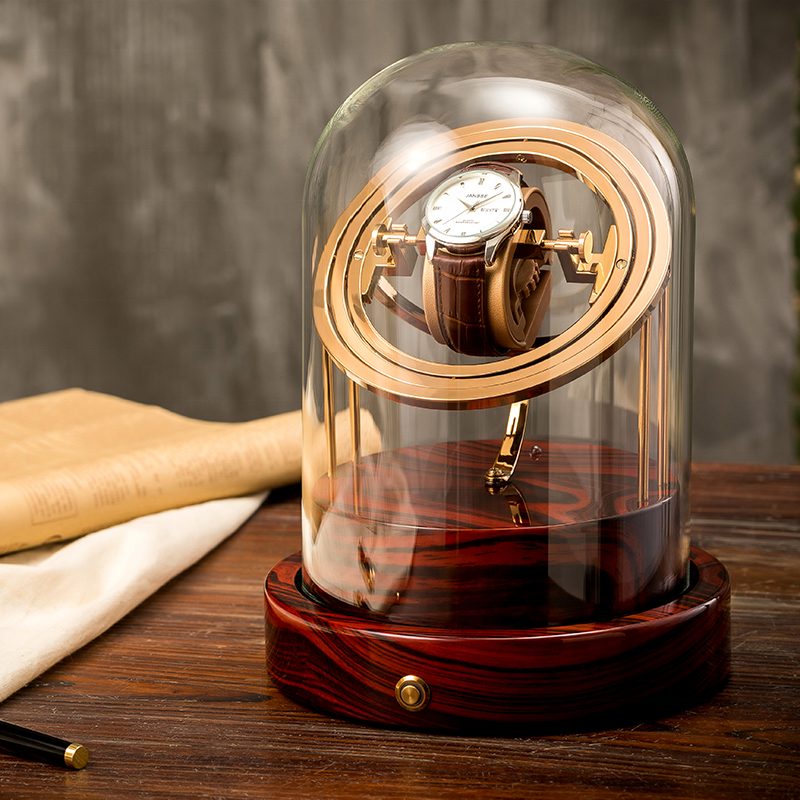
A watch winder looks like the simplest product in the watch accessory world: a box with a motor that rotates a cushion. In practice, it is the piece where technical detail and presentation quality have to coexist — and where buyers most often get burned by specs they did not check. This guide covers what actually matters when you source winders for a brand, a retail programme or a corporate gift line.
What a watch winder actually does
An automatic watch keeps its mainspring wound through the motion of the wearer's wrist. When the watch is left in a drawer, it stops — typically after one to three days depending on the movement — and the owner has to reset the time, date and any complications. A winder rotates the watch at intervals that mimic wrist motion, keeping the mainspring charged and the movement running. For a single watch, that is convenience. For a collection with perpetual calendars or moon phases, it can save a genuinely tedious reset ritual.
Who needs one — and who doesn't
Winders make sense for collectors who rotate between watches and don't want to reset them, for retailers who want display models running on the shelf, and for gift programmes, where a winder reads as a premium, functional object. They are unnecessary for anyone who wears the same watch daily. As a buyer, this matters for positioning: winders are usually a focused, higher-margin line rather than a volume product, which is why presentation and build quality carry so much weight.
Turns per day: the spec that matters most
"Turns per day" (TPD) is the number of full rotations the winder gives the watch in 24 hours. Too few and the watch stops; far too many and you are stressing the movement for no benefit. Most automatic movements need somewhere in the 500–1,000 TPD range to stay charged, which is why good winders rotate for a few minutes, rest, and repeat — rather than spinning continuously. Use the table below as orientation, then confirm the requirement for the specific movements you sell:
| Watch type | Typical requirement | Winding behaviour |
|---|---|---|
| Basic 3-hand automatic | Low — roughly 500 TPD | Minimal winding keeps it running; the most forgiving category |
| Date / day-date | Low to moderate | Same as above, with the date kept current |
| Perpetual calendar | Moderate | Kept running so the calendar never needs a workshop reset |
| Moon phase | Moderate | Continuous running keeps the moon display accurate |
An adjustable programme is more valuable than a single fixed setting, because a retailer or gift buyer never knows which movement the end customer owns.
Direction of rotation: the setting people forget
Some movements wind in one direction only, some are bidirectional, and a few are sensitive enough that the wrong direction means the watch quietly stops anyway. A winder worth buying offers clockwise, counter-clockwise and bidirectional modes. It is a small detail on the spec sheet and one of the most common reasons end customers return the product — so put it on your checklist before anything else.
Motors and noise: the detail buyers judge first
A winder usually lives in a bedroom or a shop counter, which makes noise the first thing a user notices. Motor quality shows up in three ways: an audible whine during rotation, vibration transferred into the cabinet, and long-term consistency of the timing programme. Because gear meshes and dampening differ enormously between suppliers, this is exactly the kind of specification that cannot be judged from a photo — it is what the physical sample stage is for. If you are building a winder programme, plan to hear the motor before you approve mass production.
Materials and display: the winder as a piece of furniture
Because winders run constantly, the housing is not just decoration — it is the product. Wood with a high-gloss or matte lacquer finish remains the classic choice for a premium look, paired with a leather or PU cuff that holds the watch securely without marking the strap. Glass or open framing turns the winder into a display object, which matters for retail counters. Our round-base winder design, for example, pairs a piano-lacquer wood base with a metal frame and a soft leather watch pouch — the look customers expect from the category. See how this fits into the wider range on our custom watch boxes page.
In-stock vs custom winders for your brand
If you are testing demand, starting from a ready-to-ship design is the faster route: our in-stock watch boxes and winders start from 50 units per design, under our Tancy line, and ship without waiting for tooling. Custom production starts at 500 pcs per design and is the right choice once you want your own brand identity: lacquer colour matched to your reference, your logo on the base, packaging and finish aligned with the rest of your watch line. Logo, design and process customization are all supported.
A buyer's checklist before you order
| Programme | Adjustable TPD settings and clockwise / counter-clockwise / bidirectional modes |
|---|---|
| Motor | Quiet running, no vibration into the cabinet — verified on a physical sample |
| Housing | Wood with lacquer or veneer finish; stable base, clean interior lining |
| Cuff | Leather or PU, holds strap sizes securely without stressing them |
| Branding | Logo position and finishing method confirmed before sampling |
How we produce custom winders
With 18 years in wooden and leather packaging, a 200-person factory producing 80,000 pieces per month, we build winders as part of a complete watch packaging range rather than as a one-off gadget. Custom projects start with sampling of about 15 days including 3D digital proofing and 2 rounds of revisions, followed by roughly 30 days of production. If you are planning a winder or watch box programme, send your requirements through our contact page — we reply within 24 hours.
Most automatic movements stay charged with roughly 500–1,000 turns per day, delivered in intermittent cycles rather than continuous rotation. Complex movements such as perpetual calendars benefit from being kept running continuously. Because requirements vary by movement, choose a winder with adjustable settings rather than one fixed programme.
Custom OEM / ODM winders start at 500 pcs per design, because lacquer colour, logo and structure are set up specifically for your order. If you want to test the market first, ready-to-ship designs from our Tancy line start from 50 units per design.
Yes — logo, design and process customization are all supported. Lacquer colour is matched to your reference, and logo finishing is confirmed before sampling. Send your artwork in AI, C4D or PDF format and we will confirm the options.
Sampling takes about 15 days including 3D digital proofing and 2 rounds of revisions. Mass production takes about 30 days after order confirmation. Payment is by T/T with a 30% deposit and the balance before shipment.