Watch Valet Boxes: Specifying One Wooden or Leather Organizer for Watches, Jewelry and Everyday Pieces
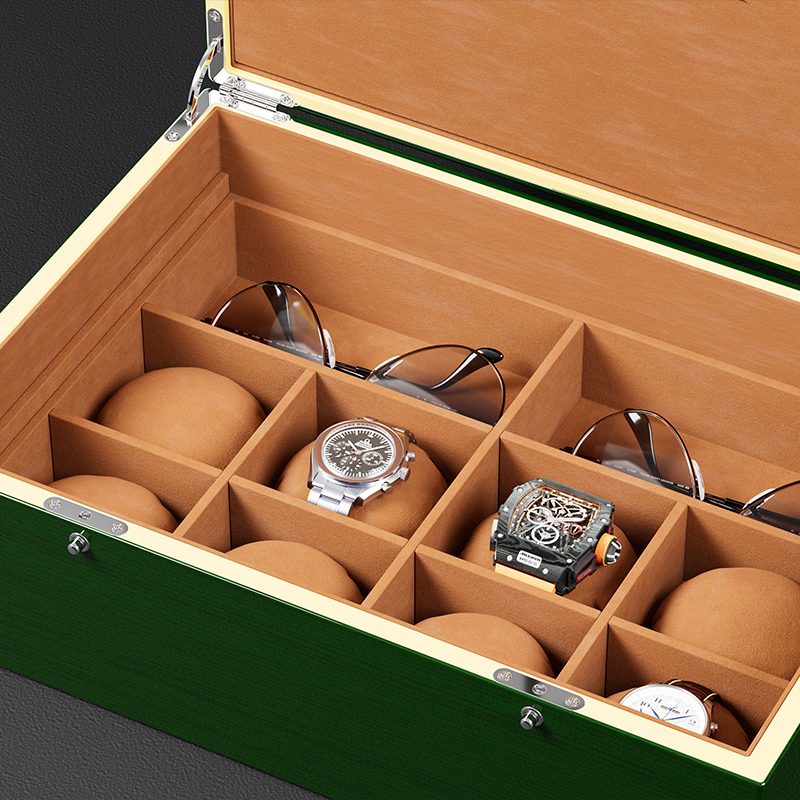
A watch box is built to hold watches. A valet box is built to hold what a person takes off at the end of the day — a watch, a ring, cufflinks, glasses, a pen, keys, sometimes a second watch. The difference sounds small until you try to design for it. Those objects have different weights, different depths and different surfaces, and they do not all want the same lining or the same clearance.
This guide is about specifying one wooden or leather organizer that holds a mixed set of pieces well. It is written from the factory side, because the decisions that decide whether a valet box works — zone depths, lining choices, lid hardware — are made on the production line, not in a rendering.
What a valet box has to do differently
A collector's case is opened now and then and closed again. A valet box is opened every morning and every evening, often one-handed, often on a crowded dresser or desk. That changes three things. The lid has to be easy to lift and safe to leave open. The interior has to stay tidy when small hard objects are dropped into it rather than placed. And the box has to sit convincingly in a room, because it is furniture that stays out rather than packaging that gets put away.
It is also a mixed-material problem. A stainless bracelet, a silver ring, a pair of spectacles and a lacquered pen should not share one loose tray: metal marks metal, hard edges scuff soft linings, and anything round rolls into the watch slots. A single deep cavity with a pillow in the middle is the most common mistake in this format.
List what actually lands on the dresser
Start with a written inventory, not a drawing. Count the watches and note the largest case diameter and the tallest bracelet, then list every other object by its real dimensions: rings, cufflinks, glasses folded and unfolded, pens, keys, coins, cards, a phone. Send those measurements with the enquiry. A well cut from a generic grid will fit the average item and fail the two extremes.
Decide at this point whether the box is for one person or a shared surface, and whether it travels. A valet box that stays on a desk can be heavy and can use a lift-off or hinged lid; one that is carried should be smaller, leather-wrapped, and closed with a catch that will not open in a bag. Those are different products, and treating them as one is where briefs go wrong.
| Item in the inventory | What it changes in the box |
|---|---|
| Largest watch: case diameter, bracelet height | Slot width, slot pitch and lid clearance |
| Rings, cufflinks, small metal pieces | Shallow wells with a lip so nothing rolls |
| Glasses, pens, keys | Long narrow channels, soft on at least one face |
| Coins, cards, a phone | An open catch-all tray, sized last |
| Whether it is carried | Weight, footprint, closure and body material |
Zones and depths, not one big tray
The interior should be planned as a set of zones at different depths. Watch slots are the deepest, because a watch on a pillow stands tall. Small-item wells are shallow, because a ring in a deep cavity disappears and has to be fished out. Long channels for glasses and pens are shallow but wide. An open catch-all tray can be shallower still.
Zone depth is a structural decision, not a styling one. It decides how the insert is built — a single wrapped moulding, stacked trays, or separate wrapped panels fixed into a wooden frame — and it decides the lid clearance, because the lid must clear the tallest watch while the small wells stay usable. Decide the depth of each zone before the exterior is drawn; changing one afterwards usually means a new insert, not a new hole in the old one.
Keep the zones in a deliberate order. The things a person reaches for first should sit at the front; the watch slots usually sit behind or beside them. A box that is logically zoned is used daily; a box that is only visually zoned is emptied into a drawer within a month.
Watch slots inside a mixed tray
Watch slots in a valet box follow the same rules as in a dedicated watch box, with one extra constraint: they share an insert with other objects, so their walls have to be stiff enough not to be crushed by a loose key or a heavy pen. Removable cushions are usually the better choice here — they let the slot be re-cut at sampling if the watch collection changes, and they can be lifted out to clean the tray.
Size the slot from the largest watch, not the average, and leave bracelet clearance above the pillow. A watch held at one point in the middle pivots and marks the lining; it should be supported on the pillow with the bracelet resting naturally. If the programme covers both a steel bracelet and a leather strap, say so at the start — the two sit at different heights.
Small-item wells: rings, cufflinks, keys and pens
Small hard objects are where a valet box is judged. Wells should have a low lip so items do not migrate into the watch slots, and corners should be rounded so a lining wrap does not lift. Cufflinks and keys are metal and will scratch each other and any adjacent silver, so give them their own lined wells rather than one shared strip. A ring roll or a narrow slot holds a ring upright and visible; a flat well lets it lie down and get scratched.
Long items need a channel, not a well. Glasses folded flat need a soft floor and enough length for the arms; pens need a channel that holds them without gripping the clip. Check these against real objects at the sample stage — a channel cut to a drawing that was never verified against an actual pair of glasses is a classic failure here.
Linings: one box, several materials
A single lining material rarely suits every zone. Suede or microfibre is the practical default for watch slots and the catch-all tray: it hides dust, holds a pillow firmly and wears well. Velvet reads more luxurious in small-item wells but shows every mark. EVA or shaped foam gives structure where a channel has to keep its shape for years. Wrapped mouldings look best on a displayed surface; moulded trays hold their geometry longest.
Check adhesion at the edges and colour consistency across the batch — a lining a shade lighter on the last two hundred units is obvious when the boxes sit together. Where silver pieces are involved, keep the lining choice in the specification and discuss it at sampling rather than assuming any soft fabric will do; some finishes and adhesives are kinder to silver than others, and that is a decision to record, not a claim to make.
A lid built for daily opening
Hardware carries more weight in a valet box than in a gift box, because it is cycled every day. Hinges should open through their full travel without binding and hold the lid at a useful angle; a soft-close hinge is worth specifying if the box sits on a polished surface. A lift-off lid is the simplest and most forgiving on tolerances, but a hinged lid cannot be misplaced — which matters for something used twice a day.
This is also where the factory-side division of labour shows. Machines do the precision work: cutting, CNC shaping and consistent surfaces produce panels that are identical to one another. The second half — wrapping leather corners, aligning wood grain across a lid and a base, setting a soft-close hinge — is done by hand, and it is where the sense of quality comes from. Around 70% of the people on our production floor have worked together for more than ten years, which is the practical reason those judgements stay consistent across a run. We have been building wooden and leather boxes for 18 years.
Check the lid fit as a functional item: it should close with even resistance, sit flush on all four sides, and not rock when set down. A lid that rocks on a dresser will eventually wear its own hinge seat.
Wood, lacquer or leather-wrapped: choosing the body
A wooden body — solid, veneered or MDF with a lacquer — gives crisp edges, a flat surface for a small mark, and the weight that keeps a box stable when one hand lifts a watch out of it. A high-gloss lacquer looks striking and shows fingerprints; a matte or open-grain wood hides both, which suits an object handled daily. A leather-wrapped body is warmer to the touch, grips better when carried, and hides the scuffs a desk-side box collects.
Neither is the premium option by default; the right one is the one that matches how and where the box lives. Keep branding restrained on a personal object: a small foil or debossed mark inside the lid, or a discreet metal plaque, reads better than a large logo on the outside. See custom watch boxes for the format family this grows from, and custom jewelry boxes and custom leather boxes for the two neighbouring bodies we build.
Sampling, MOQ and what to send in the brief
Send the inventory with real measurements, the zone plan, the lining choice per zone, the lid and hinge type, the body material and finish, the branding method and position, and the quantity. Drawings are accepted in AI, C4D or PDF. Sampling takes about 15 days and includes 3D digital proofing plus two rounds of revision, so a decision made on screen is free and the same decision made after a physical sample costs three weeks. Custom programmes start at 500 pcs per design, with production in about 30 days after sample confirmation.
Standard terms are T/T with a 30% deposit and 70% before shipment; shipments go out EXW or FOB Guangzhou by express, air or sea, and enquiries are answered within 24 hours. Every one of the ten production steps — from cutting and CNC shaping through sanding, priming, colour coat, controlled-temperature curing, polishing, hardware fitting and interior assembly to inspection and packing — is checked before the batch moves on, and third-party inspection is accepted as standard.
| Field in the brief | Why it changes the build |
|---|---|
| Inventory with dimensions, including the largest watch | Sets zone depths, slot pitch and lid clearance |
| Zone plan and order of zones | Decides insert construction and how the box is used |
| Lining material per zone | Changes wrap, adhesion and colour matching |
| Lid type, hinge and closure | Changes hardware, tolerances and daily durability |
| Body: wood, veneer, lacquer or leather-wrapped | Changes surface process and branding method |
| Branding method and position | Decides whether a die or plaque is needed |
| Quantity and shipping route | Sets tooling split and carton specification |
If the quantity is small and the specification is standard, an in-stock format is often the faster route: we hold 100+ ready-to-ship designs from 50 units, in a range of wooden and leather-wrapped cases. See in-stock watch boxes for that route, custom wooden boxes for the bodies we build, our service process for how a run is managed end to end, and contact us to send an inventory for quotation.
A watch box is built around watch slots and is opened occasionally; a valet box holds a mixed set of everyday objects — watches, rings, cufflinks, glasses, pens and keys — and is opened once or twice a day. That calls for zones at different depths, small-item wells with a lip, linings chosen per zone, and a lid and hinge built for daily use.
Yes, if the zones are specified from the start. Watch slots should be the deepest, small-item wells shallow with a low lip, and hard metal pieces kept in their own lined wells so they cannot scratch silver or roll into the watch slots. Where silver is involved, record the lining choice in the specification and confirm it on the sample.
Custom programmes start at 500 pcs per design. Sampling takes about 15 days and includes 3D digital proofing plus two rounds of revision, with production in about 30 days after sample confirmation. For small quantities and a standard specification, in-stock wooden and leather-wrapped cases are available from 50 units.
A written inventory with real measurements, including the largest watch's case diameter and bracelet height; the zone plan; the lining material for each zone; the lid, hinge and closure type; the body material and finish; the branding method and position; and the quantity. Drawings are accepted in AI, C4D or PDF, and enquiries are answered within 24 hours.