Watch Display Boxes: Window Lids, Trays and How a Box Sells on the Counter
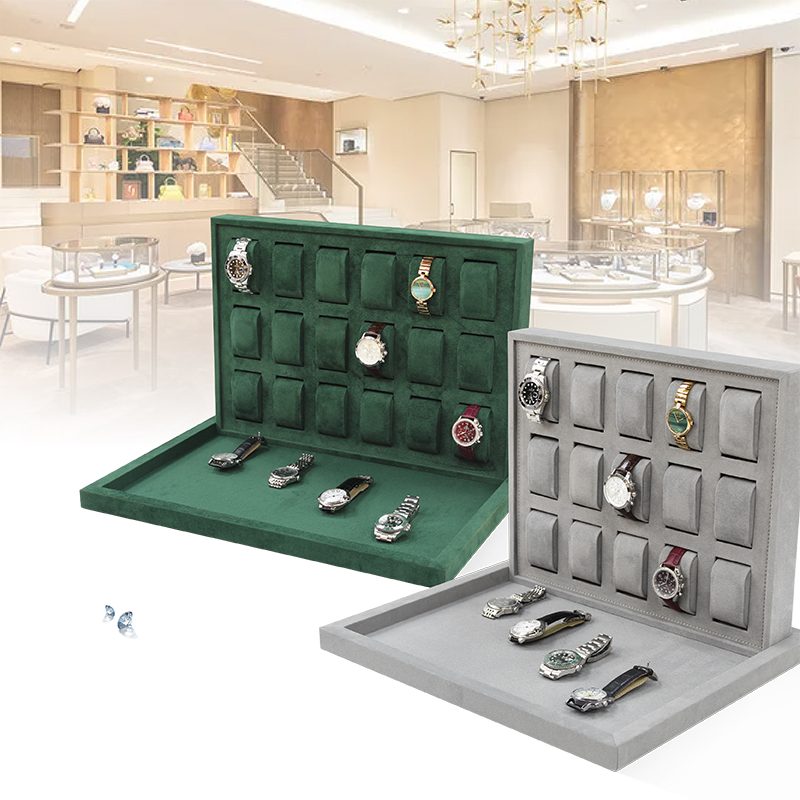
A watch is usually decided on before it is ever lifted out of its box. On a counter or in a window, the box is doing the selling: the glass, the tilt of the pillow, the way a dial catches a downlight. That makes a display format a different product from the box a watch is stored or shipped in — and it is specified differently.
This guide covers how watch display boxes and trays are planned in wood and leather: which lid material to choose, how tray layouts work at the counter, what the shelf itself demands, and what to test in the store before a programme is signed off.
What a display box does that a storage box does not
A storage box is opened at home, by one person, in ordinary light. A display box is looked at by hundreds of people who never touch it, under lighting designed to make metal sparkle, and it is opened by staff dozens of times a day. Three jobs follow from that: show the piece, protect it while it is on show, and hold the information a customer needs — reference, price ticket, brand mark.
Everything else here is a consequence of those three jobs. A window protects nothing on its own, but it removes the thin film of dust and the small hesitation of asking to see something. A tilted tray shows a dial better than a flat one, but it needs a deeper body behind it. Storage formats optimise for capacity; display formats optimise for the first three seconds.
Window lids: glass, acrylic or solid
The window is the first decision because it sets the body depth, the packing method and the freight weight at once. Glass gives the truest view and the most convincing weight in the hand, and it survives cleaning with the solvents a store actually uses. It also chips at the edges if the rebate is tight, and it adds real weight to a carton that ships by express.
Acrylic is lighter, tolerant of knocks, and can be supplied with an anti-scratch coating; it is the practical choice for a travelling display or a pop-up. What it gives up is clarity over time — fine scratches accumulate and the surface dulls under strong downlight. A solid lid gives up the view entirely, but it removes glare, which matters for photography and for stores with aggressive spotlights.
| Lid | What it gives | Where it fails | Specify carefully |
|---|---|---|---|
| Glass | Truest clarity, weight that reads as quality, solvent resistance | Edge chipping, freight weight, breakage in handling | Rebate depth and clearance, edge polish, separate packing |
| Acrylic | Light, impact resistant, printable, lower freight burden | Fine scratches, surface dulling under strong light | Coating grade, protective film, cleaning instructions |
| Solid lid | No glare, full surface for foil or laser marking, best for photography | Nothing is visible until it is opened | Lift-off versus hinged, interior presentation |
Whichever window is chosen, the frame around it is a wood or leather decision, and it sets the tone of the whole box: a lacquered frame reads as jewellery, a leather-wrapped frame reads as an accessory, and a raw-grain hardwood frame reads as an object.
Tray formats: how many watches at one view
Display formats fall into four practical layouts. The single-position box puts one piece behind glass and is the format for a statement model or a limited reference. The three-up tray runs a short row and suits a collection story told in three tiers. The six-up tray, usually two rows of three, is the workhorse of a watch counter. The twelve-up tray covers a full collection in one lift and is the format most often paired with a deeper body and a hinged lid.
A tray is one layer that lifts out; a box is a closed volume. That difference drives the rest of the specification. A tray has to be liftable by one hand with a finger recess at each end, and it has to sit flat enough that a watch does not rock when a customer points at it. A box has to clear the tallest watch on the pillow when the lid closes, which is where most first samples fail — the clearance is measured from the top of the bracelet, not from the top of the case.
The counter decides the size, not the drawing
Measure the shelf before designing anything. Width, depth and the height of the shelf above decide the format far more often than the product does, and the numbers are rarely what a brand assumes. A tray that is ten millimetres too deep will not sit square in a case; a box that is five millimetres too tall will not fit under the shelf above it.
Then plan the facings. A counter that holds six single boxes shows six references; the same footprint in three-up trays shows eighteen, which is a merchandising decision rather than a packaging one — but the packaging has to be designed around it. Modularity pays here: one tray footprint, repeated, is easier to replenish, easier to stack in the stock room, and easier to extend to a second store than a set of bespoke sizes.
Stacking needs its own thought. Two high is the practical limit for glass-lidded boxes, and the base should carry a soft lining or felt pad so it does not scratch the lacquer or glass of the box beneath it. Anything stacked higher should be a drawer unit, not a pile of boxes.
Presentation inside the window: pillow height, tilt and lining contrast
Pillow height sets where the dial sits in the frame. Too low and the watch floats in an empty box; too high and the crystal touches the glass. The target is a dial that sits just below the window, with the bracelet draping rather than bunching — which is why a display pillow is usually firmer and slightly narrower than a storage pillow of the same size.
Tilt is the other half. A flat tray is honest and easy to pack; a tray tilted a few degrees toward the customer shows the dial at the angle a wrist would. Tilt has to be built into the body, because a loose wedge in a display case gets moved, lost, or used to prop up the wrong box.
Lining colour is the cheapest way to change how a watch reads. A dark lining pushes a steel case forward; a warm light lining flatters yellow gold and makes a dial look larger. What matters at programme level is that the lining is fixed as a standard and recorded, because velvet and suede are the surfaces that drift most easily between production runs.
Light, glare and fingerprints
Store lighting is harsher than office lighting, and it is pointed. A gloss lacquer body under a downlight behaves like a second window: the customer sees two reflections and the watch in between. Matte bodies, open-grain wood and textured leather absorb that light instead, which is why so many display formats pair a glass window with a matte frame.
Then there is the surface the staff touch. High-gloss black shows every fingerprint, and in a store it is wiped twenty times a day; a matte or grained surface hides the same handling and needs less attention. If a brand insists on gloss, the practical compromise is a gloss body with a leather-wrapped base and a matte interior — the shine stays where it is admired, and the handling marks land where nobody looks.
Test this in the actual store, under the actual lighting, with the actual watch. A sample judged in a meeting room will look different in a case with a 3000K spotlight above it, and glare is the one defect that no amount of QC catches on a bench.
Handling, security and the staff who open it
A display box may be opened forty times on a Saturday. That number, not the product's elegance, is what the hinge has to survive. Soft-close hinges and lid stays matter more here than on a gift box, because a lid that falls shut on a customer's fingers ends the conversation. Where a box is left open on the counter for hours, a stay that holds at a wide angle is worth specifying.
Security is usually handled by the case rather than the box, but the box has to cooperate: a discreet cable channel or tether point, a lock that a keyholder can operate without lifting the piece out, and a price ticket that does not have to be stuck to a lacquered lid. Adhesive on gloss lacquer leaves a mark that cannot be polished out on site — a ticket pocket in the lining, or a small tag on the tray edge, avoids the problem entirely.
Serviceability is the last piece of the same argument. Pillows and linings wear before the body does, so a display format should allow both to be replaced without rebuilding the box. On a programme that runs for years across several stores, that one decision decides whether the estate stays presentable.
How a display box is built and checked
The body runs through ten stages: wood cutting, CNC forming, fine sanding, primer, colour coats, controlled-temperature curing, polishing, hardware fitting, interior assembly, and inspection before packing. Machines hold the precision — panel dimensions, slot pitch, the flatness a lacquer needs before it can be polished. Hands do what machines cannot: wrapping leather around a corner without a crease, aligning grain across a lid and its base, setting a hinge so the lid slows at the last few degrees.
That split is also why the people matter. Most of the production team has been together for a decade or more, so the person assembling a repeat order has usually assembled that format before. Each stage is checked before the box moves on, and third-party inspection is welcome before shipment — for a display programme, that inspection should include the box under store-like lighting, not only dimensions and finish.
Quantities, sampling and what to send
Custom display formats start at 500 pcs per design. Sampling takes about 15 days and includes 3D digital proofing plus two rounds of revision, which is where window material, pillow height and lining colour should be settled — all three are cheap to change on screen and slow to change on a physical sample. Production runs about 30 days after sample confirmation.
For a first store or a small pilot, the stock range is the faster route: 100+ ready designs under the Tancy label, from 50 pcs per style, which is enough to fit out a counter without committing to a tooling programme. Many brands start there, learn what the counter actually needs, and specify custom once the layout is proven.
Payment is T/T with a 30% deposit and 70% before shipment. Shipments go out EXW or FOB Guangzhou by express (DHL, FedEx, UPS) or by sea in FCL or LCL, and enquiries are answered within 24 hours. Drawings are accepted in AI, C4D or PDF.
| What to send | Why it changes the specification |
|---|---|
| Shelf dimensions and case photos | Sets tray footprint, height and stacking |
| Number of references and watches per view | Decides single, three, six or twelve up |
| Watch dimensions, bracelet type, weight | Sets slot pitch, pillow firmness and lid clearance |
| Window preference | Changes body depth, packing and freight weight |
| Body and lining colours | Sets surface process and the contrast the piece reads against |
| Store lighting photos | Decides gloss or matte frame, glare risk |
| Opening frequency and locking needs | Sets hinge type, stay and lock specification |
| Quantity and destination | Sets tooling plan and freight mode |
See custom watch boxes for the full format range, in-stock watch boxes for ready designs from 50 pcs, watch box interiors for pillow and slot detail, the luxury watch box guide for the details that decide whether a box reads as premium, and contact us to start a brief.
A display box is built to show one to twelve watches behind a window in retail light, and to survive being opened by staff many times a day; a storage box is built for capacity and protection at home. Display formats usually tilt the tray, keep the pillow firm and add a liftable tray, while storage formats prioritise slot count and lid clearance.
Glass gives the truest clarity, convincing weight and solvent resistance, at the cost of freight weight and edge chipping if the rebate is tight. Acrylic is lighter and impact resistant and suits travelling displays, but fine scratches accumulate and the surface dulls under strong downlight. Many programmes pair a glass window with a matte body to control glare.
Custom designs start at 500 pcs per design, with sampling of about 15 days including 3D digital proofing and two rounds of revision, then production of about 30 days after sample confirmation. Stock designs under the Tancy label are available from 50 pcs per style across 100+ ready styles, which suits a single counter or a pilot.
View the sample in the store or under lighting similar to the store, with the actual watch in it. Check dial height against the window, glare on the glass, lid clearance over the bracelet, how the tray lifts with one hand, hinge and stay behaviour at the angle it will be left open, and whether a price ticket can be placed without adhesive on the lacquer.