Skincare Packaging Boxes: Holding Cream Jars, Droppers and Tubes in Wooden and Leather Cases
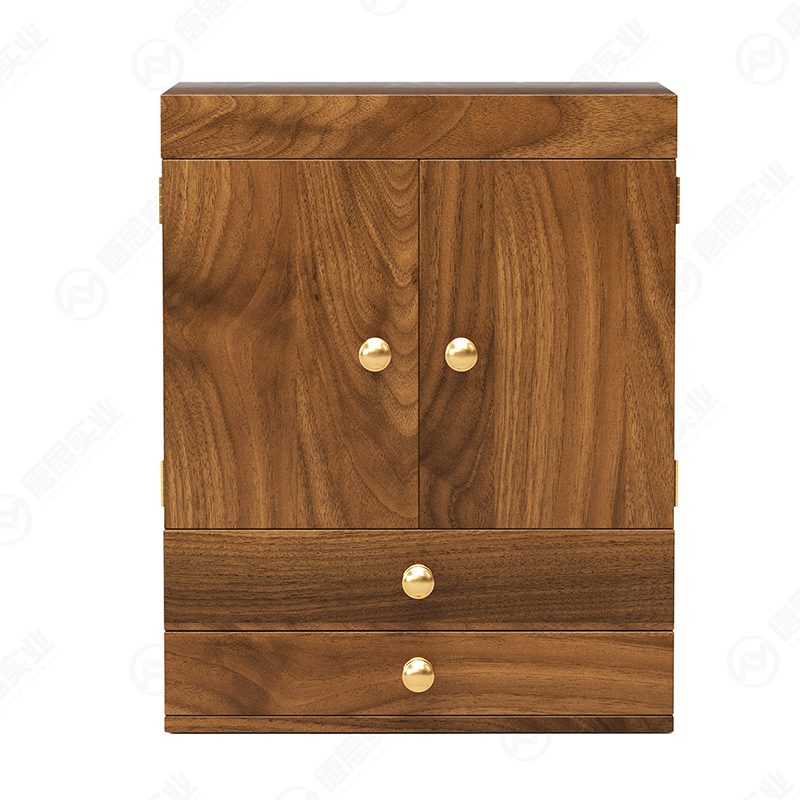
A high-value product needs packaging that sets it off, and skincare asks something more specific of a box than fragrance does. A perfume bottle is tall, narrow and heavy at the base; a skincare set is a small crowd of unrelated shapes — a wide cream jar, a slender dropper bottle, a soft tube, perhaps an ampoule or a pump. Each wants to be held differently, each can leak, and each has to be lifted out by fingers rather than tipped. Designing the box around them is a geometry problem before it is a styling one.
This guide covers how cream jars, droppers, tubes and ampoules are held in wooden, lacquered and leather-wrapped presentation boxes: what each container shape asks of its cavity, how inserts are built, how the body and finish are chosen, and what has to be verified on a physical sample. It is written for custom cosmetic boxes and the skincare programmes behind them.
Skincare is not perfume: what changes in the brief
It is tempting to reuse a fragrance box for a serum or a cream. The two fail differently. A glass fragrance bottle is usually heavy for its volume, seated on its base, and protected mainly against shock and a cap wider than its body. Skincare containers are often lighter, wider at the shoulder, and more likely to be opened and closed repeatedly by the customer after purchase. A wide jar is lifted out from above, so the cavity needs finger clearance on both sides. A dropper bottle is top-heavy and tips easily. A tube has no fixed shape at all once it is partly used.
That changes the priorities. Fit still matters, but so does removal, standing stability, and how the lining behaves if a product leaks. It also changes what the box is: a secondary presentation layer around containers that the brand fills and seals itself, not a substitute for that primary pack. Any requirement for materials that sit near the product belongs in the brief and on the sample, not in a marketing claim.
Start from the containers, not the box
Every dimension in a skincare box is derived from the containers. Send the real items, or drawings in AI, C4D or PDF, with base diameter, widest shoulder, cap or pump diameter, and total height for each one. A jar whose lid is wider than its body needs a stepped cavity; a dropper whose rubber bulb sits above the glass needs headroom; a pump head needs clearance so it is not pressed in a closed box. A cavity cut to a nominal size will rattle a slightly smaller container and refuse a slightly larger one.
If the programme covers more than one size — a 30 ml serum beside a 50 ml cream, or a travel size beside a full size — say so at the start. The usual answers are a removable collar, a two-part insert or a shared cavity with a divider, and all of them have to be tooled during sampling rather than added after the insert is cut. List the lining, any foam, the adhesive, and any elastic or tab as separate specification fields, so the quotation and the sample describe the same thing.
Cream jars: wide, heavy and lifted from above
A cream jar is short, wide and denser than it looks, especially in glass. It wants a shallow cavity with a flat seat, a controlled clearance around the shoulder, and enough room on two sides for fingers to lift it out. A deep well that fits the diameter exactly is a trap: the jar goes in and cannot be removed without tipping the box. Where the lid is wider than the body, the cavity needs a step or a collar, and that step has to be cut rather than approximated.
Jars also concentrate weight low in the box, which matters when a set ships. Ask for the closed box to be shaken and cycled on the sample, and check that the jar cannot rotate in its seat — a round jar in a round cavity will turn with every movement and scuff the lining. A shaped EVA or foam cradle, a wrapped moulding, or a rigid moulded tray each solves this differently; whichever is chosen, the jar should be supported at its base and shoulder, never gripped by the lid.
Droppers and serum bottles: tall, narrow and top-heavy
Dropper bottles invert the problem. They are tall for their footprint, light at the base and heavy at the cap, so they tip as soon as a carton is tilted. An upright cavity must be deep enough to support the body at two heights, with a collar or a shaped neck support near the shoulder, and the lid must clear the bulb without pressing it. A bottle held only at its base will pivot; one pressed from above can depress the dropper.
For a set that ships directly to a customer, consider whether the bottles travel upright or lie in shaped channels. Upright presentation looks better on a shelf and reads as a regimen; lying flat is more stable in transit but changes the box footprint and the reveal. Settle that at the 3D digital proofing stage, where a change costs nothing. Glass still needs the same respect it gets in fragrance packaging: no hard contact between bottles, no void for them to travel in, and no pressure on the closure.
Tubes, pumps and ampoules: the awkward shapes
Tubes have no fixed geometry. A full tube is a firm cylinder with a crimped end; a half-used one is a soft, collapsed shape that will not sit in a cavity cut for the full version. Give a tube a channel it can lie in with the cap located at one end, rather than a tight round well. Pumps need headroom and a clear path for the actuator; ampoules need individual cells or a strip so that glass never touches glass. Spatulas, cotton pads and sample sachets belong in a separate compartment, not loose in the same well as the containers.
| Container | What the cavity has to do | Common mistake |
|---|---|---|
| Cream jar | Flat seat, shoulder clearance, finger space on two sides | A deep well the jar cannot be lifted out of |
| Dropper or serum bottle | Two-height support, neck collar, bulb headroom | Holding only the base, or pressing the dropper |
| Tube | A channel with a located cap end | A round well sized for a full tube only |
| Pump bottle | Actuator clearance, no downward pressure | A lid that closes onto the pump head |
| Ampoule | Individual cell or strip, no glass-on-glass contact | Loose ampoules sharing one compartment |
Where a set mixes several of these, a removable tray or a two-tier arrangement lets one box serve a changing seasonal mix. Cut every compartment from the real items, not from a nominal drawing, and check the adhesive line and colour consistency across the batch.
Inserts that hold without gripping
The insert does the work. EVA and shaped foam give structure and forgiveness for a box that ships directly; velvet- and suede-wrapped mouldings look better on a shelf and are the standard for gift sets; rigid moulded trays hold their shape longest and suit a box that will be opened for years. Fabric-wrapped mouldings are the combination most premium boxes actually use — a firm core with a presentation surface bonded over it.
Two rules apply to every skincare insert. First, hold the container at two points without force and without rattle, and never by its closure. Second, specify the interior as a list of materials rather than one name, because the lining, the foam, the adhesive and any elastic all share the same closed air as the product and all have to be checked on the sample. A lining that stains or holds residue is a poor choice for a product that may be opened and closed daily; ask for a wipeable surface where that matters, and state any requirement for materials near the product at sampling so it can be verified. Every coating layer must be fully cured before the interior is assembled.
Wood or leather: choosing the body and the finish
Skincare boxes often sit on a vanity or a bathroom shelf, so the body has to survive handling and look deliberate at close range. A lacquered body gives crisp edges and a flat surface for branding, and a high-gloss piano finish is built up in layers with curing and polishing in stages; a matte lacquer hides fingerprints better but shows sheen variation between spray batches. A veneered body gives the warmth of wood with less movement than solid wood, and grain direction should be specified so the lid and base read as one surface. Solid wood gives the most substantial feel and needs the most care in drying and construction.
A leather-wrapped box gives a softer hand-feel and hides the scuffs a kept box picks up, and it supports the double-door, drawer and multi-tier formats that larger regimens use. Be precise about what the wrap actually is: outer covering, inner substrate, surface texture, and lining or insert are four separate fields, and a photograph cannot prove which one is being quoted. Wrapped corners should be taut with no lifted edges; a handle should be fixed into the frame with a plate behind the panel rather than driven through a veneered surface. Machines cut the panels to identical size; aligning the grain, wrapping a corner and setting a soft-close hinge are done by hand, and that is where the sense of a made object comes from.
Sets, refills and the second life of the box
A skincare programme rarely ships one container forever. A single cavity suits one hero cream; fixed dividers suit a three-step regimen; removable trays let one box serve a changing seasonal mix; a drawer or second tier adds tools, spatulas or sample sachets without disturbing the bottles. Multi-tier, pull-out and double-door formats all appear in premium beauty gifting, and the choice is mostly about how many items have to be visible at once and how the customer is meant to reach them.
If a refill programme is planned, design the box to be kept and the insert to be replaceable. That is a different brief from a single-use presentation: the closure will be cycled for years, the lining has to survive cleaning, and the box should still look right once the original product is gone. Keep the branding restrained — a mark sits well on a lid, a clasp plate or a metal nameplate, and sits badly repeated across a lining where it competes with the product. Barcodes and SKU labels belong on the outer export carton, not on a lacquered lid.
Sampling, quantities and what to verify
Custom programmes start at 500 pcs per design. Sampling takes about 15 days and includes 3D digital proofing plus two rounds of revision; production runs about 30 days after sample confirmation. Use the sampling window on what a render cannot show: compartment fit against the real jars and droppers, whether a tube can be lifted out, the lid closing flush on all four sides, the hinge cycling, the grain match, the smell of a closed box after a few weeks, and the wobble of a dropper bottle when the packed carton is moved.
Ask for the packed sample as well as the bare one. Each box needs an individual protective wrap, corner protection where a lid or doors project, and a five-ply export outer carton sized to the finished box with no void. Each of the ten production steps is checked internally before a batch moves on, and third-party pre-shipment inspection is accepted as standard. Standard terms are T/T with a 30 percent deposit and 70 percent before shipment, so the natural inspection point is before the balance is released. Enquiries are answered within 24 hours, design files are accepted in AI, C4D or PDF, and certifications held include ISO 9001, FSC, CE, RoHS and REACH.
| Specification field | Why it belongs in the first enquiry |
|---|---|
| Real containers or drawings: base, shoulder, cap, total height | Sets every cavity, collar and lid clearance |
| Upright or lying down, and the reveal sequence | Fixes the footprint, structure and tooling |
| Single product, fixed set or removable trays | Decides dividers, tiers and future SKU changes |
| Insert, lining, foam, adhesive and wipeable surface | Holds the containers and survives real use |
| Body, finish, grain direction and the four wrap fields | Controls stability, cleaning and appearance |
| Logo method, artwork files and approved colour reference | Aligns branding across wood, lacquer and wrap |
| Quantity, outer packing, shipping route and delivery date | Aligns MOQ, production and freight |
Shipments leave on EXW or FOB Guangzhou terms by DHL, FedEx or UPS express, or by FCL or LCL sea freight. For the glass-bottle side of the same problem see custom perfume boxes; for insert and lining choices see custom jewelry boxes; and for the bodies these cases are built on see custom wooden boxes and custom leather boxes. Our service process sets out the six stages from brief to delivery, and contact us to send a container list for a skincare programme quotation.
A fragrance bottle is tall, narrow and heavy at the base, so the box is built mainly around shock protection and a cap wider than the body. Skincare containers are wider at the shoulder, lighter, opened repeatedly after purchase, and more likely to leak. The priorities become finger clearance for lifting a jar out, standing stability for a top-heavy dropper, and a lining that can be cleaned.
EVA or shaped foam for boxes that ship directly to a customer, velvet- or suede-wrapped mouldings for gift sets on a shelf, and rigid moulded trays for a box that will be opened for years. Hold each container at two points without force, never by its lid or pump head, and give a dropper bottle a neck collar plus headroom for the bulb.
Yes, if it is specified that way from the start. A removable collar, a two-part insert or a shared cavity with a divider lets one box take more than one size, but each has to be tooled during sampling — it cannot be added after the insert is cut. Send the real containers or drawings in AI, C4D or PDF with base, shoulder, cap and total height.
Custom programmes start at 500 pcs per design. Sampling takes about 15 days and includes 3D digital proofing plus two rounds of revision, with production in about 30 days after sample confirmation. Standard terms are T/T with a 30 percent deposit and 70 percent before shipment, and third-party pre-shipment inspection is accepted.