Box Opening Styles Compared: Lift-Off, Hinged, Drawer and Double-Door Wooden Boxes
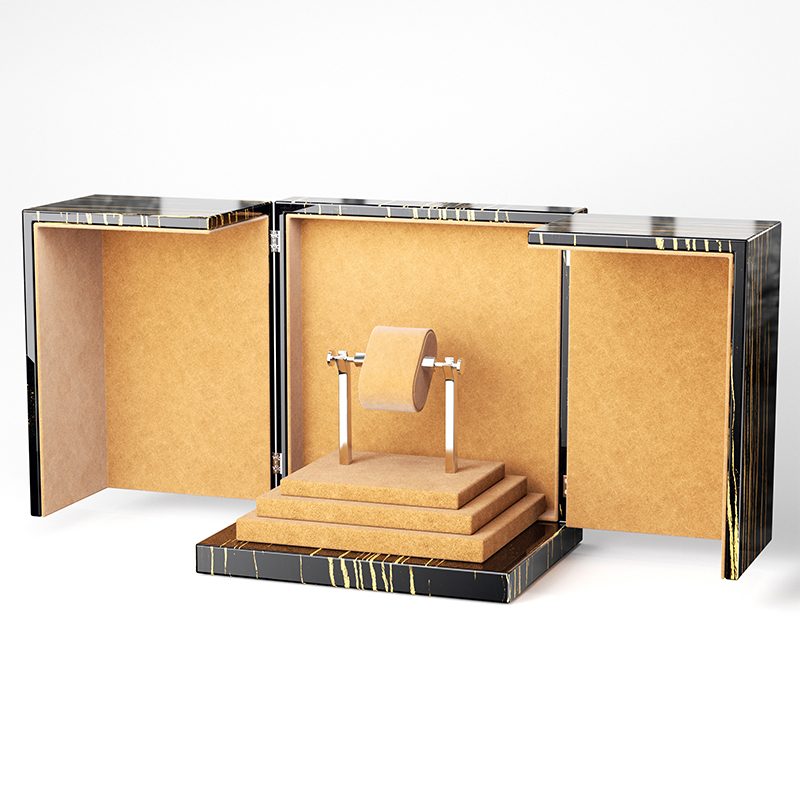
The way a box opens is usually treated as a styling decision, something to settle once the material and the finish are agreed. On a wooden or leather-wrapped box it is a structural decision, and it is made early whether you make it deliberately or not. The opening style fixes the panel sizes, the tolerances, the hardware, the insert, how the box packs into a carton, and how much of the product is revealed at once. Change it after tooling and you are not editing a detail — you are rebuilding the box.
This guide compares the four opening families a buyer is most often choosing between — lift-off lids, hinged lids, drawers and slide-out sleeves, and double-door or book-style cases — and sets out what each one does to cost, protection and the sampling programme. It is written for wooden, veneered, lacquered and leather-wrapped bodies, which behave very differently from a folded sheet.
Why the opening is a structural decision, not a styling one
A rigid box is an assembly of panels that have to agree with each other. The opening style decides how many panels there are, where the joints fall, and which edges have to stay straight under load. A lift-off lid needs a base and a lid that meet on four sides with even friction; a hinged box needs a leaf, a pin and a lid that stays aligned every time it closes; a drawer needs a sleeve and a tray with clearance on all four faces; a double-door case needs two leaves that meet in the middle without a visible gap.
Those differences propagate. They change how the wood is cut, how the veneer is matched across the lid and the body, where a hinge can be seated, how deep the insert can be, and how the finished box sits in an export carton. It is worth deciding the opening in the brief rather than discovering it on a sample, because sampling is where a change becomes expensive.
Four opening families at a glance
| Opening | How it works | Best fit | Watch for |
|---|---|---|---|
| Lift-off lid (two-piece) | Separate lid drops over or onto the base | Gift sets, single products, presentation boxes | Friction fit and lid-to-base grain match |
| Hinged lid | Lid stays attached and swings on a hinge | Boxes kept on a desk, opened often | Hinge seating, lid alignment, soft-close setting |
| Drawer / slide-out sleeve | Tray slides out of an outer sleeve | Sequenced reveals, thin products, travel formats | Clearance, binding, a way to pull the tray |
| Double-door / book-style | Two leaves open from the centre | Ceremonial launches, paired products, cabinets | Centre seam symmetry, latching, hinge load |
The table is a starting point, not a ranking. Each family has a version that is cheap to tool and a version that is not, and the right one depends on how often the box is opened and what has to happen in the first three seconds.
Lift-off lids: the simplest mechanism, the hardest fit
A two-piece box has no hinge, no pin and no moving parts, which makes it the most forgiving to manufacture and the easiest to pack flat. It is also the least forgiving on fit. The lid has to slide on with even resistance — tight enough not to fall off when the box is lifted, loose enough not to bind on a humid day — and it has to sit flush on all four sides with no rocking. That tolerance is measured in fractions of a millimetre across a wooden body that moves with moisture.
Grain is the second trap. On a veneered or solid-wood box, the pattern should read continuously from lid to base. Machines cut the panels to size; aligning the grain across the joint is done by hand, and it is one of the details that separates a box that looks made from a box that looks assembled. If a lift-off lid is your choice, specify the grain direction and the lid depth in the brief, and check both on the physical sample rather than on a render.
Hinged lids: the default for a box that stays on a desk
Anything that will be opened daily — a watch case, a jewellery box, a collector cabinet — usually wants a hinge. Keeping the lid attached means it cannot be set down and lost, and it lets the interior be laid out in tiers or trays that would fall out of a lift-off lid. The cost is a new set of tolerances: the hinge leaf has to be seated into the frame rather than screwed through veneer, the lid has to close without rocking, and the pin has to stay aligned through the full travel.
Specify the hinge as a part, not a wish. Leaf length and thickness, opening angle, whether a stay or lid support holds it open, and whether a soft-close action is wanted are all separate decisions. A soft-close hinge is set and checked by hand — it is one of those operations where the machine delivers the precision and the assembler delivers the feel. Ask for the hinge to be cycled repeatedly on the sample; a hinge that binds at one point in its travel will eventually tear out of its seat.
Drawers and slide-out sleeves: sequencing the reveal
A drawer turns the opening into a sequence. The outer sleeve stays still, the tray comes out, and the product is revealed in stages — useful when a set contains several items that should be seen one at a time, or when the box has to be thin. Multi-tier versions stack trays, and a removable tray lets one box serve more than one product mix.
The failure mode is binding. Wood and MDF move with humidity, and a tray cut too close to its sleeve will jam; cut too loose and it rattles and looks cheap. Clearance has to be designed in from the start, along with a way to pull the tray — a finger recess, a ribbon pull or a metal tab — and a stop so the tray cannot be pulled straight out onto the floor. Drawers also need a decision about what lines the inside of the sleeve, because that surface is visible every time the tray moves.
Double-door and book-style cases: ceremony at a cost
Two leaves opening from the centre is the most theatrical format and the most demanding to build. Both doors have to be the same width, both hinges have to carry the same load, and the centre seam has to close evenly from top to bottom. Any asymmetry is immediately visible, because the eye goes straight to the middle of the box. Book-style and suitcase-style cases, with wrapped corners, metal corners or corner plates, rivets and a latch or clasp, belong to this family.
This is where a latch earns its place. A magnetic catch should hold under a lifted load, not just under finger pressure, and a mechanical clasp should be positioned so it does not fight the grain or the wrap. Handle attachments belong in the same conversation: a handle should be fixed into the frame with a plate behind the panel, not driven through a veneered surface that will eventually pull out. Double-door cases are worth the tooling for a launch or a high-value set; they are rarely worth it for a replenishment item.
What the opening style changes downstream
Four things follow the opening decision. First, tooling: jigs, moulds for inserts and cutting programmes are built around the panel sizes, so a late change means new tooling rather than an edit. Second, the insert: a lift-off lid can take a deep cavity, a hinged box needs clearance for the lid to close, and a drawer needs the product to stay seated while the tray moves. Third, hardware: hinges, stays, catches and handles are specified per format, not picked from a catalogue after the fact. Fourth, packing: a box with a projecting lid or a pair of doors needs different corner protection in the carton than a plain two-piece box.
All of it sits inside a ten-step production sequence — cutting the board or solid wood, CNC shaping, fine sanding, primer, colour coat, controlled-temperature curing, polishing, hardware fitting, interior assembly, and inspection and packing. Each step is checked before the batch moves on, which is why a decision made at the brief is free and the same decision made after a physical sample costs weeks.
How to specify the opening in your brief
Name the opening style in the first enquiry, not in a later email. State the opening angle for a hinged box, the pull method for a drawer, the seam tolerance for a double-door case, and the lid fit for a lift-off. Say how often the box will be opened and whether it will be carried, because both change the hardware. Send a reference photo or a sketch alongside the dimensions — design files are accepted in AI, C4D or PDF — and ask for the opening to be shown in the 3D digital proofing stage, where a change costs nothing.
Custom programmes start at 500 pcs per design. Sampling takes about 15 days and includes 3D digital proofing plus two rounds of revision, with production in about 30 days after sample confirmation; enquiries are answered within 24 hours. See custom packaging boxes for the programme options, custom wooden boxes and custom rigid boxes for the bodies these openings are built on, and our service process or contact us to put an opening style into a quote request.
A two-piece lift-off lid is usually the simplest, because it has no moving parts and the fewest fittings. But it is the hardest to get right on fit, and a veneered lid that has to match grain across the joint adds hand work. The cheapest opening is the one that fits how the box will actually be used, not automatically the simplest one.
It is possible but expensive. The opening sets the panel sizes, the jigs, the insert mould and the hardware seating, so a change means re-tooling and a new sample rather than an edit. Settle it in the 3D digital proofing stage during the roughly 15-day sampling window, where two rounds of revision are included.
Not always, but they need a specified hinge. Leaf length and thickness, opening angle, a lid stay and whether the action is soft-close are separate decisions that belong in the brief. A soft-close hinge is set and checked by hand, so ask for it to be cycled repeatedly on the physical sample.
The opening style, overall dimensions, how often the box is opened, whether it will be carried, and a reference photo or sketch. Design files are accepted in AI, C4D or PDF. Custom programmes start at 500 pcs per design, with sampling in about 15 days and production in about 30 days after sample confirmation.